Your Warehouse Can Now Answer Questions. Literally.
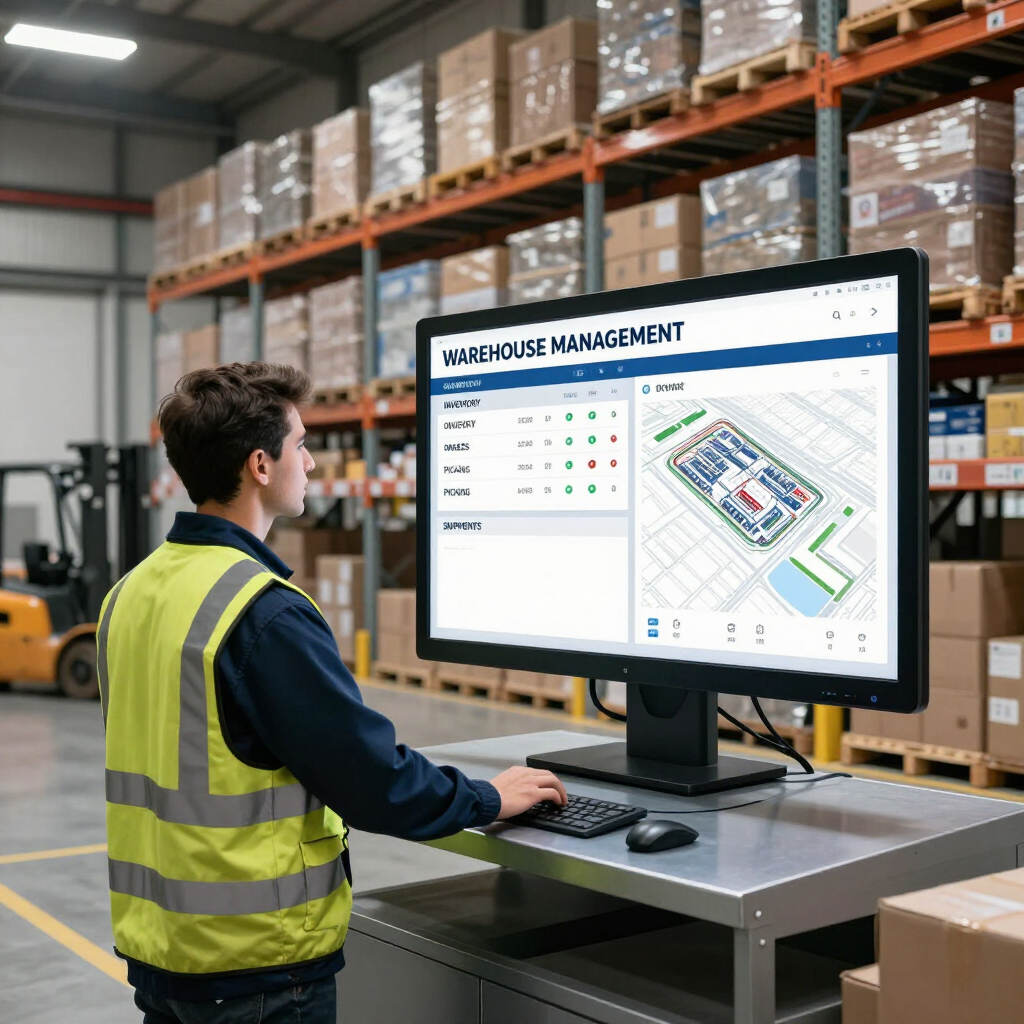
Picture a warehouse supervisor at 7:45 AM, coffee in hand, trying to figure out whether last night's freight actually went out. The old way: open TBO4, click into the freight queue, cross-reference against the pick board, maybe pull a report, maybe ask someone who already left for the day. Ten minutes later, an answer — if you're lucky.
The new way: she types "did everything ship that was supposed to ship last night?" into a chat window. Three seconds later, she has her answer, plus the two consignments still sitting in the queue and why.
That's the TBO4 MCP Server. It doesn't replace TBO4 — it gives it a voice.
Most WMS platforms, TBO4 included, were never short on data. Pick history, bin contents, receiving audits, freight consignments — it's all there. The bottleneck has always been access. Getting an answer meant knowing which screen to open, which filter to apply, or worse, knowing enough SQL to ask the database directly.
That's fine for the people who live in the system all day. It's a wall for everyone else — the operations manager who wants a quick pulse check, the new hire who doesn't know where cycle count variances live, the executive who wants last month's numbers without waiting for someone to build a report.
The TBO4 MCP Server tears that wall down by making the warehouse itself conversational.
So what actually is MCP?
MCP stands for Model Context Protocol — an open standard from Anthropic that defines how AI models talk to outside systems. Think of it as an API built specifically for AI assistants rather than for other software.
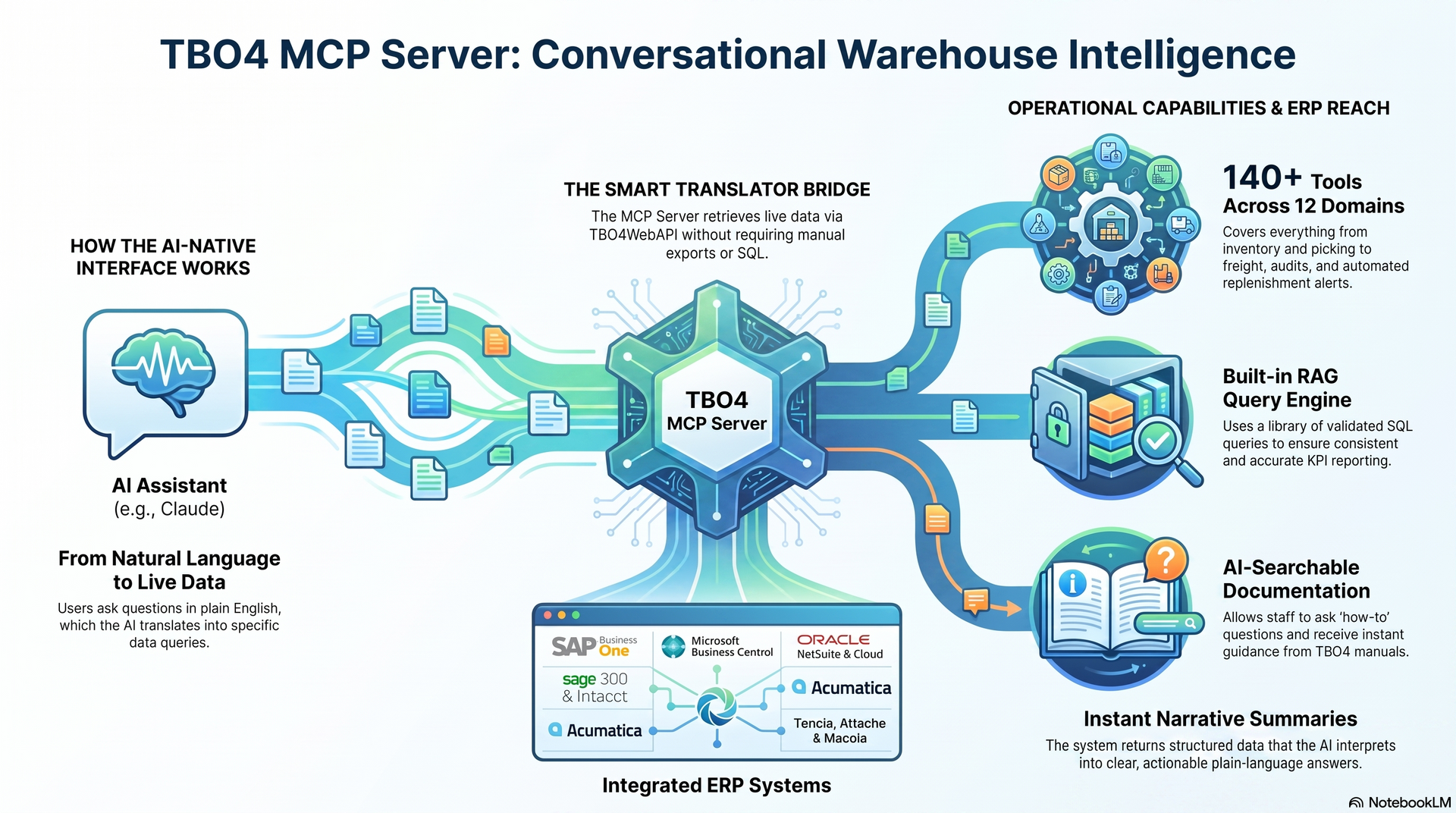
Here's the simplest way to think about it: if TBO4 is the Warehouse database and the usual TBO4 screens are the UI and dashboard, the MCP Server is the translator standing between your warehouse data and an AI assistant like Claude. Ask a question in plain English, and the MCP Server fetches the real, live answer from TBO4 — no export, no report builder, no waiting.
It's not a chatbot bolted onto a WMS This is the old way and was never practical for the warehouse users. It's a structured bridge that lets an AI ask TBO4 the same questions a person would and get back the same trustworthy data.
What you can actually ask it
This is where it gets fun, because the range is wide. A few real examples:
Operations, in the moment:
"What's stuck in the pick queue right now?" or "Which freight consignments haven't manifested yet?" — instant situational awareness, no screen-hopping required.
Performance, on demand:
"Who picked the most orders this week?" or "What are our top 10 SKUs by volume received this month?" — the kind of question that used to wait for a scheduled report now gets answered before your coffee gets cold.
Investigation, without the spreadsheet:
"Show me every stock adjustment over the last 30 days where the variance was more than 5 units" — a cycle count discrepancy that would normally take a careful cross-reference between two screens now resolves in one sentence.
Onboarding, without a manual:
"How do I process a return receipt?" — because the MCP Server doesn't just expose live data, it can search TBO4's own documentation and hand a new operator the right answer instead of pointing them at a 40-page PDF. Also can complete work flows and documentation for SOPs.
That last one matters more than it might seem. A WMS that can explain itself reduces training time and support tickets in equal measure.
Under the hood, briefly
You don't need to understand the architecture to benefit from it, but it's worth knowing the MCP Server isn't a separate system pretending to know about your warehouse — it sits directly on top of TBO4 and TBO4 WebAPI, and pulls from the same ERP connections you already have, whether that's SAP Business One, SAGE Intacct, Microsoft Business Central or Acumatica.
When someone asks a question through an AI assistant, the flow looks like this: the AI figures out what's being asked, calls the right tool on the MCP Server, the MCP Server queries TBO4's live data, and the answer comes back in plain language — usually in a couple of seconds. Easy to understand from operator to stakeholder.
No new system to learn. No data migration. No disruption to how TBO4 already runs. It's additive, not a rip-and-replace.
Why this matters more than it sounds like it should
There's a quieter shift happening underneath the obvious convenience. Every WMS vendor talks about reporting and dashboards. Almost none of them have built a system where the data itself is natively legible to an AI — where you don't need a custom report, a BI tool, or a data export to ask a sharp question and get a sharp answer.
That's the real positioning here: TBO4 isn't a warehouse system with an AI feature tacked on. With the MCP Server, it becomes a warehouse system that was built to be asked about, in whatever way the question naturally comes out of someone's mouth.
For teams already leaning into AI tools like Claude across the rest of the business, this isn't a novelty — it's the natural next step. The warehouse stops being the one part of the operation you have to log into separately to understand and starts being just another thing you can ask.
At The RIC Group we have always been ahead of our competitors technically and we have now kept ourselves ahead with the release of our MCP Server.