If you've shopped for a modern WMS recently, you've probably heard a lot about SSCC labels — and rightly so. Serial Shipping Container Codes are the backbone of retailer compliance, and any platform worth considering should generate them automatically. But there's a quiet assumption baked into a lot of WMS marketing: that printing a compliant label is the same thing as managing the pallet.
It isn't. And the gap between the two is where a lot of warehouses quietly bleed accuracy, time, and visibility.
What an LPN Actually Is
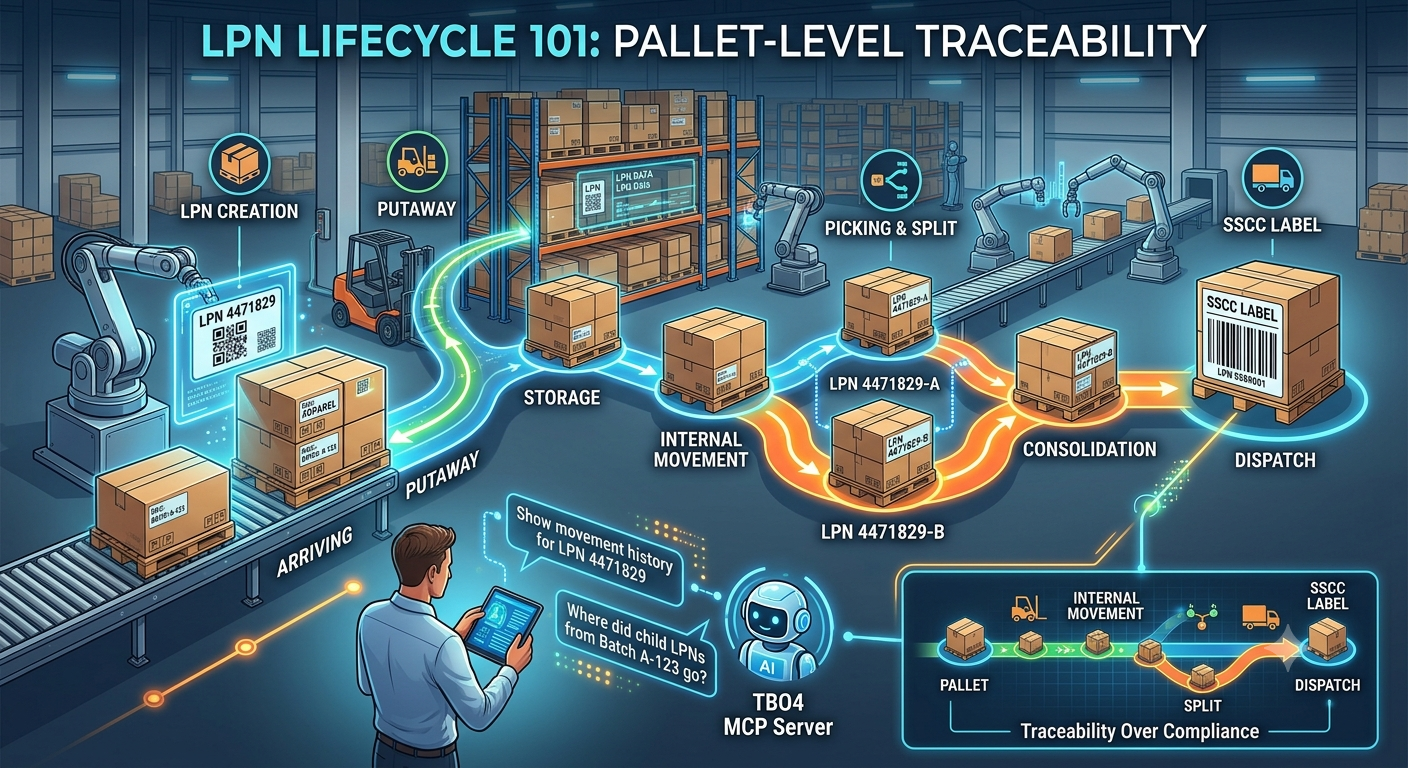
An LPN — License Plate Number — is a unique identifier assigned to a unit load (usually a pallet, sometimes a carton or container) the moment it's created, and carried with it through every single thing that happens to it afterwards: putaway, storage, replenishment, consolidation, splitting, movement between locations, picking, and eventual dispatch.
The key word is lifecycle. An LPN isn't a label you print at the end of a process. It's an identity the pallet holds from the moment it exists in your four walls until the moment it leaves them — and in mature systems, its history persists even after that, for traceability and recall purposes.
Where SSCC Labels Fit — and Where They Stop
An SSCC label is a shipping artifact. It's generated to satisfy a retailer's compliance requirement or a carrier's manifest format, typically printed once a pallet is finished, checked, and ready to leave the building.
That's a genuinely useful thing to have automated. But it answers a narrow question: "What's leaving, and does it meet the receiving party's labeling standard?"
It doesn't answer the questions that actually drive warehouse performance:
- Which exact pallet is sitting in bay C-14 right now, and what's on it?
- When this pallet was split into three during a pick, did all three child loads retain traceability back to the parent?
- If a batch needs to be recalled, which specific pallets — not just which SKU — need to be pulled, and where are they?
- When cycle counting flags a variance, which physical unit load does that variance belong to?
A platform that generates SSCC labels well can still leave you blind on all of the above, because label generation is a point-in-time event, not a tracking model.
The Three Places "Label-Only" Systems Quietly Fail
1. The middle of the journey. Plenty of systems track a pallet accurately when it's received and again when it's dispatched — but visibility during storage, replenishment, and internal movement is thinner. If your LPN doesn't persist through every location move, you don't actually have pallet-level traceability. You have two accurate snapshots and a gap in between.
2. Splits and consolidations. Real warehouses don't keep pallets intact. They get split for picking, merged for consolidation, restacked for space. A true LPN lifecycle model carries genealogy through these events — a child LPN knows which parent it came from. Systems built primarily around end-of-process labeling often lose this thread, because it was never the problem they were designed to solve.
3. Recall and audit scenarios. This is where the difference stops being theoretical. When a quality issue surfaces — a contaminated batch, a mislabeled product, a customer complaint tied to a specific delivery — the question isn't "which SKU," it's "which physical pallets, and where did they go." Full LPN lifecycle tracking answers that in minutes. Label-only tracking often means reconstructing the answer manually from dispatch records and hoping nothing moved in between.
Why This Matters More as Warehouses Scale
At low volume, the gap between "we print compliant labels" and "we track full pallet lifecycle" is survivable — a supervisor can usually reconstruct what happened by memory or by walking the floor. That stops being true as volume, SKU count, and multi-channel complexity grow. The businesses that feel this gap hardest are exactly the ones scaling fastest: multi-site operations, anyone under retailer compliance obligations, and anyone in a regulated or batch-traceable category (food, pharma, cosmetics) where "we think it was that pallet" isn't an acceptable answer.
Traceability Is Only Useful If You Can Actually Query It
Here's the part most WMS platforms miss even when they do track LPN lifecycle properly: the data existing in the database isn't the same as the data being usable in the moment someone needs it.
Ask most systems "show me every pallet this batch touched" or "where has LPN 4471829 been in the last 30 days" and the honest answer is: someone opens a report builder, picks the right filters, waits for it to run, and exports it. That's fine when you have a day. It's not fine when a customer is on the phone asking about a recall, or an auditor is standing in your office wanting an answer now.
This is exactly where native AI-agent access changes the equation. With TBO4's MCP Server, that same question can be asked directly — in plain language — and answered from live data, without anyone building a report first:
- "List every LPN associated with SSCC labels printed for Customer X last week."
- "Show me the full movement history for pallet LPN 4471829 — every location it's been in, in order."
- "Which pallets from batch B-2291 were split, and where did the child LPNs end up?"
That's not a hypothetical dashboard feature — it's the same underlying LPN lifecycle data this article has been talking about, made queryable on demand by an AI agent instead of locked behind a report someone has to know how to build. Full pallet-level traceability is only as good as how fast you can get an answer out of it, and that's the gap most "we track LPNs" platforms still haven't closed.
The Real Question to Ask Any WMS Vendor
Not "can you generate SSCC labels" — most platforms can. Instead:
"If I split a pallet during picking, does the system track both resulting loads back to the original LPN? And if I need to trace a batch six months from now, can I find every physical pallet it touched — not just the order it shipped on?"
That question separates a system that manages labels from a system that manages pallets. TBO4's advanced pallet management is built around the full LPN lifecycle — creation, movement, splits, consolidation, and dispatch — precisely because label compliance was never the hard part. Traceability is. And with native MCP Server access, that traceability is available the moment someone asks for it, not the moment someone finishes building a report.